Sunday, October 30, 2011

Birds in the Landscape


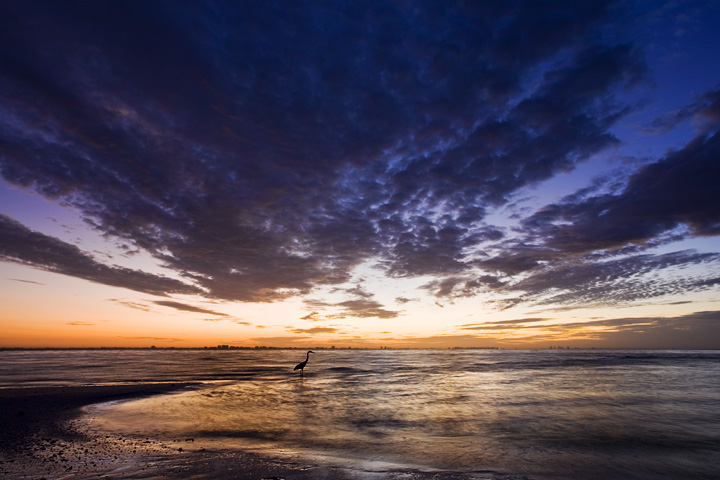
The other day I was on my favorite beach, at the lighthouse on Sanibel Island. It was after first light but still well before sunrise. The sky was teasing me with a prospect of glory.  I walked along the beach to the point, an ephemeral little spit of sand, Point Ybel, the easternmost tip of Sanibel. I couldn't stay long. I had an appointment to keep. My go-to wide angle zoom, the 17-40mm f4, was mounted on the camera. I set the tripod as low as I could without kneeling – didn't want sandy wet knees on my office-casual slacks. The sky was nice; the clouds had good form, converging lines.   Now I could see that the color would not explode; the sunrise wouldn't be spectacular – but nice. I exposed a couple of frames. Time was running short. Just as I was about to pick up the tripod, in flew a great blue heron. So, I stayed. My first exposures upon arriving had been 20 to 30 seconds or so, but now, as the approaching sunrise brightens the sky, exposure time has dropped to less than 2 seconds. The heron is actively hunting, moving about in front of me, but he does hold still for a second or two from time to time. He is relatively small in the frame, but still, a small enhancement, a kernel of interest to an otherwise unexceptional skyscape. So I give it a shot. Mirror lock-up is enabled, so it takes two clicks to open the shutter, then a second or two later another click as the shutter closes. I shoot rapidly, every time he stops, hoping to catch him in one of his motionless pauses. Click-click, click. Click-click, click. Click-click, click. Finally, I grab the tripod and hurry back along the beach towards the car, “For I have promises to keep, and miles to go...” before the sun rises.


Birds are usually photographed with telephoto lenses. Wide angle lenses are usually used for landscapes. To make a landscape with a wide angle lens with a bird in the foreground means that one must be rather close to the bird for it to show as more than a speck. Occasionally the birds tolerate a stealthy close approach. Usually not. In the photograph above, a flock of gulls casually fled in twos and threes as I crept closer, little by little, to make the composition I wanted.  Then one of the remaining pair raised its wings just for me. Although the sunbeams I had hoped to capture beyond the pier were fading, my patience was rewarded with one of my favorite photos.


Sometimes I compose a photograph around a bird or sometimes the birds just happen to be in the scene or are just passing through.  Sometimes the birds are just a little garnish and sometimes they appear serendipitously, like an unexpected cherry on whipped cream.


Often, in the low light of early morning, the shutter speed simply is not fast enough to stop the motion of a moving bird, especially a bird in flight. We get an unidentifiable blob, a blurry dark streak against the sky. On occasion, a bird will stay still long enough for a longer exposure, a motionless silhouette against satin surf.  But mostly not.


No matter the circumstance, birds in the landscape are always just a little bit special.


Friday, October 14, 2011

Skyway

For years I've had an image in my mind's eye of the sun rising under the Tampa Bay Skyway. On a recent business trip to St. Petersburg, I had my opportunity.   I checked out of my hotel at 6:00 a.m. and drove to Fort Desoto Park, arriving shortly after first light.   Just my luck – there was heavy cloud cover on the horizon.  It looked like I wouldn't be seeing the sun this morning.   Nevertheless, I used The Photographer's Ephemeris app on my iPhone to position myself in just the right location on the East Beach to see the sun clear the horizon directly behind the main span of the cable stayed bridge.   It was still fairly dark so I made some exposures of the bridge with its cable stays lit. (200mm, 30 seconds)  I hadn't even considered photographing the bridge at night.  My dark background is clouds, not a night sky.


As it grew lighter, the lights on the stays faded. There was some color in the sky. It was nice, but not spectacular.  I savored the morning and the solitude, photographically exploring the bridge and the sky as the light changed.  After a while, I strolled back to where I had left my car.  A man doing yoga on the beach was the only other person I saw. 


Once again, as usual, I didn't get what I went for.  The images I came back with aren't prize winners, but it certainly wasn't a wasted effort.  I do so enjoy the early morning.

Monday, October 3, 2011

Another Month, Another Moon

The moon in September is known by various names, the harvest moon, the corn moon – but nothing with the cool name appeal of the moon of August. A month after failing to catch the Sturgeon Moon setting over the Sanibel lighthouse, I was at it again. In my mind's eye, I see the lighthouse silhouetted against the orange face of the man in the moon. From the north end of Fort Myers Beach it only sets in the sweet spot a few times a year, near the equinoxes (equini?). When it happens on a weekend morning, there I am. 


Sunday morning, a little before six, I walk down the boardwalk to the beach.  In the dark distance I see bright lights down the beach.  It's an excavator working on the beach re-nourishment project.  It's predawn Sunday morning. They must be working twenty-four seven. They're way behind schedule.  I hope they aren't where I need to be, about half a mile south.   Lots of small clouds are moving fast in the sky, covering and uncovering the moon. I hope they don't cover the moon when I need for them not to. Walking fast, soon I come to the orange mesh fence around the work area. They've left a narrow pathway at the back of the beach. The clouds seem mostly to have moved away by the time I reach the far end of the orange fence, and this is the spot I need to be. I extend the legs of the tripod as I walk to the water's edge. I plunk the tripod down.

“Oh, no!” The bubble level is not in the hot shoe. It had just arrived on Monday, a replacement for the last one I had lost. I cursed. 

The moon was over the lighthouse. A long streak of moonlight reached from the lighthouse, three miles across the Gulf of Mexico, to the lazy little waves licking at my feet. Most of the light clouds in the sky had cleared but I could see a line of clouds on the western horizon, their tops awash in moonlight. I wouldn't be getting my shot this morning. It was now an hour before sunrise and the moon would set in less than 15 minutes. It would sink into the clouds well before that, and we would never know whether it actually set or not. I exposed one frame at 40mm and removed the camera from the tripod to mount the long lens. It was still dark as night. The bright full moon in such a dark sky would be a difficult exposure to reveal any detail on the far shore. I knew from experience that with the 300mm lens, an exposure of longer than five seconds would be spoiled by the movement of the moon. With an aperture of f8, I boosted the ISO to bring the time down to five seconds. I made a couple of exposures and then opened all the way up to f2.8 to reduce the exposure time even more. I later discovered that that was a mistake. The wide open aperture was unkind to the light of the lighthouse, turning it into a glowy little blob instead of a nice many-pointed star. Less than five minutes after my first exposure, the moon touched the clouds and then was gone. I began making plans for Monday morning; the moon would set later; it wouldn't be so dark. I could still be in the office by eight. 


I want to find my hot-shoe bubble level, but it's too dark to see. So I idly fidget, waiting for the sun to come up. As the dawn begins to make its presence known I kill some time playing with long exposures of a great blue heron, working the light surf, with the Fort Myers Beach Pier half a mile away as a backdrop.

Finally it was light enough to see and I began retracing my steps and scanning the sand for my little green cube and vowing to keep the next one in my vest and only to put it in the hot-shoe when I needed it. I missed a glorious red sky and sunburst behind the motels, beach houses, and condos. Rats and other four letter epithets! I found a pool of red rose petals that I hadn't seen before in the dark. Somebody got married last night. But my new bubble level is gone forever.


Monday morning. I'm on the pier. The moon set is just after sunrise. I’ll be making the picture almost an hour later than yesterday – completely different conditions. The sky was full of fast-moving clouds, but clearing. As the sky lightened, I put on the 300. Then added the 1.4x teleconverter as the moon fell closer to the lighthouse and grew paler in the haze. And then replaced the 1.4x with the 2x teleconverter for 600mm as the moon nestled into the clouds above the lighthouse. 


 Oh well, there's always next month, or next year.

Monday, September 19, 2011

A Birthday Poster

The inspiration for this effort was a mural seen in a home decor store - a gymnast on a balance beam, silhouetted against a block wall with a stripe painted across it.  Well, we didn't have a balance beam or striped wall, so we did what we could with what was at hand.  Mary Margaret did several walkover, back-bend, and handstand poses, fretting that she'd kick a light or knock something over. 

We submitted one of her handstands to USA Gymnastics for the 2011 Year of the Handstand project.  Click here to see that picture in USA Gymnastics' gallery of handstand pictures.

I wanted the floor and foreground to be white, so I couldn't set up the lighting to create a silhouette of Mary Margaret.  I digitally converted her image to a silhouette, retaining just a bit of detail.  The color of the softened-edge stripes, applied with a slight gradient, was sampled from cell-phone photos of her bedroom accents.  The green is supposed to be 'artichoke', but I guess it's really closer to 'bell pepper'.  It is better than my fist attempt, which Mary Margaret derided as color swatch green.                                    

The final print of the poster is 24 inches by 36 inches - for Mary Margaret on her eleventh birthday, September 19, 2011.


Happy birthday, Mary Margaret!


Saturday, September 10, 2011

Back to Back

Or - Sometimes self-critique is futile


I like to photograph the old business district of our little one-horse town in the early morning, when there aren't so many parked cars along the curb, hardly another person on the sidewalks (aside from those who sleep there), and I can set up in the street without having to dodge traffic. Driving down First Street one evening I had seen the glow emanating from the front window of the lobby of the Bradford House Apartments, and had made a mental note. So, early one morning I set up across the street from the Bradford and started exploring compositions. A fellow came striding along the sidewalk into the light of the streetlamp. It was about half an hour before sunrise. He saw me behind my tripod across the street. “I hope you don't mind me in your picture“ he said with a smile in his voice, as he walked up to his mailbox. “Nope, that's fine,” I said. “If you don't mind holding still for twenty seconds.” He froze, in the act of inserting his key into the mailbox.  I pressed the shutter button. The exposure was 15 seconds, actually.  “Okay, thanks.” I said, releasing him from his pose. He got his mail, turned, nodded, and went through the door to the apartment lobby. He had caught me before I had found the composition. I worked at it a while longer and then moved on, still not having found what I was looking for.

Later, reviewing the results of my efforts, there were no keepers. But somehow I couldn't delete the picture of the young man getting his mail at the entrance to the Bradford House. The composition breaks the rules. Rules are made to be broken, right? No, this was inadvertent.  I'm so habituated to the standard rules of composition I have to make a conscious effort to shoot outside the box. What is this - the rule of halves? So why didn't I discard this picture? It's that young man, a stranger on a deserted city street - he was an active participant in making the picture.  I almost never include people in my photographs. If I do, they are little specks in the distance. But here is a person, clearly, obviously, a subject element of the photograph. And not only that – I had interacted with him. I'd never done that before. So this picture is different – for me.

It's all wrong. The palm divides the picture in two, right down the middle. The young man at his mailbox, near the right edge of the frame, is staring out of the frame. The bench on the other side is facing the other way, facing out of the other side of the frame. It's almost as if it's two pictures, back to back. Maybe somebody sitting on the bench would have helped, I complain to myself. But there wasn't anybody on the bench. There wasn't another soul around – just him and me, briefly, in the early morning light of the street lamps. I can self-critique this picture, but not objectively.  Why did I not discard it?  Is it because there is a human figure in it? I don't think that's it.  It was that brief interchange with a stranger.  That's what made it special for me, and corrupted my objectivity

Really, I know it's just a so-so picture; mediocrity, digitally preserved for posterity. But for me it captured a moment and isn't that why so many of us love to make photographs?  And some photographs, like some blog posts, are better than others, or not.

Tuesday, August 23, 2011

Infestations

Today on the radio I heard a news report about somebody being pulled from alligator infested water. It seems that whenever there is a water rescue or a plane goes down in water, it's alligator infested. Well, not always - sometimes it's snake and alligator infested. Unless, of course, it's in the ocean, in which case it's shark infested waters. 

Reporters love to add drama, to use hyperbole. They don't really know much, especially about nature. A reporter's knowledge is a mile wide and an inch deep, a radio reporter once told me.  If a body of water is a mile wide and an inch deep, it's snake infested. When something happens in a place with any semblance of being natural, it's always reported as being infested with whatever wildlife it may happen to be the natural habitat of.

When the county condemned our hoarder neighbor's house, the first thing they did was have it fumigated to kill all the rats. Now, that's infested! When reporters tell us about something happening in alligator and snake infested waters, that's their shorthand for shallow freshwater in the southeastern United States. When they say shark infested water, they mean seawater.


Saturday, August 20, 2011

The Gitzo Scotch Tape Fix

Or, how to keep your old classic purring

Gitzo is the gold standard for tripods. It is the tripod against which all others are compared. I've had my Gitzo 1325 for about 10 years. It's sturdy, rigid, and lightweight. I couldn't live without it, photographically speaking. It's also the most maintenance intensive piece of gear I own. It's like a Jaguar XK-E: an amazingly beautiful, high performance machine that leaves an oil stain on the garage floor.

It's the leg joints – collet-style twist lock leg joints. They've been redesigned and newer Gitzo tripods don't have the same kind of leg joints as my old 1325. That's a good thing. The leg joints are the reason I selected the model 1325 in the first place. It has fewer of them. The 3 in the model number means each leg has three sections, two joints per leg as opposed to four sections with three joints per leg. The four section models will collapse into a smaller package, which is nice if you're a frequent flier. But I've got no use for that extra trio of joints.  The new leg joints (from what I've read – not from personal experience) solve the leg joint issues. This article is about the old-style leg joints. So, if you've had your Gitzo for a while, this may be of interest to you.

After long use, the leg joints have to be tightened down harder to lock. If you don't give them that extra bit of snugness they slip, which is really annoying. So you cinch the lower leg locks a little tighter to make sure they're snug and then you have to tighten the upper ones more, to loosen the lower ones. Then they get so tight, they're hard to loosen. And eventually, they just won't tighten enough to keep the legs from slipping. The standard way of dealing with this is to replace the fiber bushings in the leg joints. It's not a big job – routine maintenance. Easier than changing the plugs in the old Jag. When you order the replacement bushings, they come in a bag of three of each and every size that Gitzo makes. And they cost about fifty bucks – Ouch. And then you have a bag full of extra bushings that fit Gitzo legs of different diameters than the legs on your tripod.

I replaced the bushings for the first time when my 1325 was a few years old. I replaced them the second time a couple of years later. Then not too long after that, one of the legs started to slip again. For some reason, I hadn't thrown out the old bushings, so I selected a used one that seemed to be in pretty good condition, and replaced the bushing in the offending leg. That did the trick – for a while at least. A few months later when the symptoms recurred, I read about a fellow who suggested wrapping the bushings with Teflon tape, the kind made for pipe threads. I tried it and it worked - temporarily. After a few uses the leg began to slip again. The Teflon tape had disintegrated.

When I disassembled the tripod, I discovered that swapping the lower legs around didn't matter. Regardless of which lower leg section, it was the one in a particular middle section that slipped. This told me that it must be the inside of the leg into which the bushing fits that was worn, not the bushing itself. I tried putting a strip of scotch tape around the inside the leg section. Man, that is practically an impossible feat – much harder to accomplish than one might think. So I gave up on that idea and I tried putting a strip of scotch tape on the outside of the fiber bushing. That seemed to help. So I put two strips of tape, one on top of the other, around the outside of the bushing. It worked!

Yes – but surely it's a make-shift band-aid repair. It wont last any longer than the Teflon tape did. Surprisingly, that's not the case. After three months, the scotch tape fix is holding up just fine. I began getting the symptoms in another leg, so I added the scotch tape to the bushings in the lower leg joints of both remaining legs. When I did that, I inspected the scotch tape on the first bushing. It looked just as good as the day I first put it on.

Wednesday, August 17, 2011

Mt. Sanibel

Redux from the past, by popular demand


Mt. Sanibel towers above the clouds as its slopes are lit by the rising sun, captured by my trusty Graflex Speed Graphic press camera from the copilot's seat as Amelia put the Electra 10E into a tight bank. Little Ellie was helping me review the morning's shoot in the darkroom. "Volcano!" she exclaimed as this image materialized in the tray.