Tuesday, November 27, 2012

HopeLine - For Melissa

Melissa Morrison had finally broken off her rocky relationship with her fiance.  Her sister Julie had warned her to stay clear of him, but as he had done before, he wormed his way back into her life.  Julie's worst nightmare came true on Easter Sunday, 2011.  He shot and killed Melissa in her Tampa apartment. 

Julie Noble is pissed off. She doesn't want her sister Melissa's murder to become just another statistic of domestic violence. She's working with the Verizon Wireless Hopeline program. Hopeline collects and refurbishes old cell phones and gets them to women in abusive relationships. A person in trouble doesn't need to have a phone service plan to call 911. All that's needed is a working cellular phone.  After being turned away by several large businesses for help in posting or distributing information about Hopeline, Julie found Joe's Crab Shack's Chelsea Ward. With support from Dal Tile and through a promotion by Joe's Crab Shack in October, Julie and Verizon collected 406 cell phones and 330 accessories and Verizon donated $1500 to ACT, Abuse Counseling and Treatment.  Following the month-long promotion at Joe's, Julie and Chelsea asked if I would make some photographs to illustrate their efforts. These are three of the photos we made together.

ACT reports that 40% of homicides here in Lee County in 2011 were related to domestic violence. At the end of October, ACT's shelters for victims of domestic violence were full.

 
Julie doesn't want other families to learn about domestic violence the same tragic way she and her family did. She wants to get across three important messages:
  1. To victims in abusive situations now: You need to start thinking about the abuse you're enduring the way schools think of bullying - zero tolerance, not 1,2,3 strikes you're out - because your life is not a baseball game and you might not make it to the 3rd strike.

  2. To family members of loved ones in trouble: Get involved. Speak up. Voice concerns. Take action! A loved one angry at you for meddling is still alive. A loved one gone because you didn't do enough becomes a painful memory.

  3. To our community: Step up! We need help to bring attention to this epidemic nationally. It takes a village to raise our kids; it takes a community to raise awareness.


To learn how you can donate your old cell phone, click here.


© 2012 Buck Ward             The Photographist                www.buckward.net         
Verizon HopeLine graphics used with permission

Tuesday, November 20, 2012

I Love the Beach

I love the beach. I always have.   Especially a deserted beach, all to myself.   In a resort area, a deserted beach is hard to come by.   So I like to go early in the morning. It's not always deserted, but it's usually not too crowded. I go to the beach for photographic opportunities. But going to the same beach over and over again... I know, the same old tired photographs.  But...I love the beach.   Let the pix fall where they may.

So I went to the beach, full photo paraphernalia and all.  I had it all to myself. Quiet. Solitude. Nature's beauty. I found a photograph to make - no footprints, a little tide pool, a reflection of the lighthouse, a nice cloud pattern, a lone plover. It took several tries 'til finally the plover held still for the entire five-second exposure.   It's not a great photograph, but it expresses my quiet pleasure.   I can't help but smile as I remember.

As sun neared the horizon, I walked, strolled, sauntered, along the beach towards the point. As the sunrise grew closer, the pale lavender gradually shifted toward the red. And then, almost suddenly, the color became dramatic. The pelicans and the terns seemed to revel in the glory. The redness erupted into fire for a brief few moments and then faded quickly as Sol entered the sky. This dramatic sunrise color swelled, peaked, and faded in a scant six or seven minutes.

I love the beach.


© 2012 Buck Ward        The Photographist       www.buckward.net

Wednesday, November 7, 2012

The River District in Fog

Please, Ma, just let me sleep a little while longer. I'm tired. Oh, well, it's after five, and I'm awake. Might as well get up. A little later than usual, but wait, we were supposed to set the clocks back an hour, so its really not even five yet. Yeah but the sun comes up an hour earlier than it did yesterday. I showered, shaved, dressed, and went outside to check the weather. Hey, we've got fog! Oh, man. I was lying in bed wasting our first fog of the season.

I hurried downtown, to the River District, thinking of scenes of streetlights receding into foggy oblivion.   At my first set up, on narrow Dean Street, after a couple of tentative exposures, a car turned in at the other end of street and stopped, its headlights shining into my lens. The passenger got out, opened the trunk, and started unloading packages. The headlights stayed on.   *Sigh*   I moved on.  It was beginning to get light. I was losing the deserted-city-in- the-middle-of-the-night look I was trying for.   I muddled around framing the Model A in front of Ford's Garage. Not too bad, but that was my last opportunity on this foggy morning for that kind of a scene, as the darkness seeped out of the misty air.

I like black and white photography, but in heavy fog I usually prefer a color photograph. Fog reduces contrast, mutes color, and hides detail. I like black and white photographs with plenty of contrast, and distinct highlight and shadow. What little color there may be in a fog photograph helps to subtly define shapes, texture, and depth; to make amends for the loss of highlight and shadow.

Illumination by incandescent streetlight gives a strong red-yellow color cast to a photograph. In fog the hue seems to fill the air. An adjustment of the white balance in this photograph of the Model A on First Street reduces the too-strong orangey color, and gives the color photo the look of a monochrome photo with a sepia tint.

As the morning light matured the streetlights went out, and I drifted along in the fog. A photograph of Joe's in the fog is so different from the one I made last year; nice reflection again, though.

I meandered over to the yacht basin. The pilings, standing tip-toe on their own reflections in the still water, seemed to float on nothingness.  An old gent on his boat called out, “Hey, are you taking my picture?” I hadn't even seen him there. He had just bought the boat, a good sized power yacht, from up on the Peace River two days before. The fog had delayed his departure. He was going up the Caloosahatchee to Lake Okeechobee and then on to Jupiter, his home port. Yes, I had taken his picture, but it didn't survive the cull.


© 2012 Buck Ward        The Photographist       www.buckward.net


PS.
I prepared this on my nice color-calibrated monitor.  Today I saw these photographs on a different monitor.  They all have a sickly greenish cast, especially the top one.  So, if they look off to you, sorry about that.

Saturday, November 3, 2012

Orionids


My intention was to catch a falling star.  I got to the beach about an hour before first light.  The night was clear and dark, but not much happening in the way of meteors.   The Orionid meteor shower was pretty much a no-show.   But I enjoy looking at the night sky. 

From left to right across the bottom: Bright Sirius, the dog star, then the familiar shape of Orion, Jupiter above the V-shaped horns of Taurus the Bull, and to the right of Taurus, the Pleiades, an open cluster also known as The Seven Sisters. At the top of the frame are the twin stars Castor and Pollux in the constellation Gemini.  And one little shooting star.

The nice thing about being at the beach early in the morning, there's usually something to enjoy, a distant thunder storm, a flock of gulls, or just being there.

The next morning I did it again, and again not was much happening in the sky, but I had the pleasure of meeting a friend who enjoys the same sort of thing.   All in all a good weekend.

© 2012 Buck Ward        The Photographist       www.buxpix.net

Saturday, October 6, 2012

Metamorphosis

Or, how  changing conditions can change your photograph

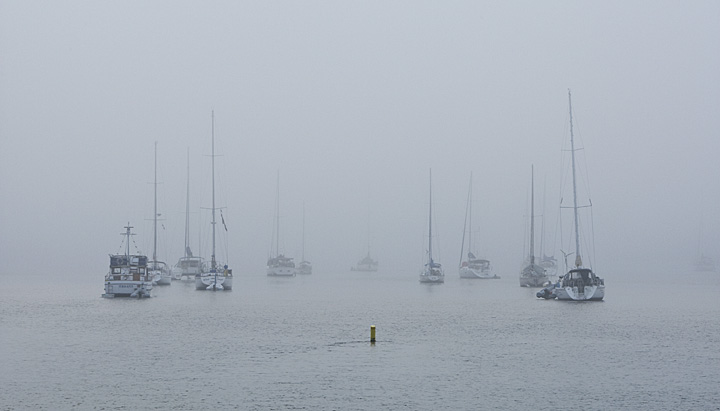
As I stood on the fishing pier under the bridge, a dinghy made its way towards me in the twilight.  I had composed, but I waited for the small boat to clear my frame. It would have been a blur, a dark smudge, amongst the yachts, even though I had increased the ISO to 800 to shorten the exposure time.  When the dinghy cleared, I made my first exposure. This first photograph was exposed for five seconds, which can be seen in the blur of the buoy in the center foreground. Fortunately the yachts were still enough that their motion is not apparent – their masts aren't blurred and masthead lights aren't distorted.  Even though it was fairly dark, there is some detail visible, lit by the industrial-strength lights on the shrimp docks some distance off to the the left.


The next photograph was made just a few minutes later, a little before sunrise, with a nice pink sky. I had reduced the ISO to 200.  The faster shutter speed, 1/2 second, made a difference in the buoy, as well as the texture of the water and the sky.  The yachts are more in silhouette due to the brightness of the sky. This might have been a good candidate for a graduated neutral density filter to bring out more detail in the yachts, and perhaps to lighten the dark band of fog beyond, without overexposing the sky. 

A fellow carrying his morning coffee walked up to me on the pier and struck up a conversation. He lives on one of the yachts I had been photographing. He pointed it out to me, but I was never really sure which one was his. I asked if he had come in on that dinghy earlier. He said that he had, that he was bringing his wife in so she could go to work. He told me all about how he had sold the house and bought the 40-year-old boat, and had been working on it, fixing it up. When he finished getting it ready they were going to let it take them down through the Caribbean and along the coast of South America. We chatted for a while and then he excused himself to go get his second cup of coffee. The fog bank that had been beyond the anchorage was rolling in, engulfing the yachts.  I made my final exposures.  Less than an hour had elapsed since exposing the first photograph. Changing conditions had given me three different photographs of the same scene.  Time for my second cup, too.


Some technical stuff about white balance-  
All three of these photographs were made with a manual white balance setting of 5500K, which approximates a daylight setting.  The colors you see are just as they were captured by the camera. Automatic white balance, AWB, would have warmed the first photo, cooled the second, and I think it would have slightly warmed the third. That is, AWB would have reduced the apparent differences in color among these photographs.  When I first started shooting digital, a set the white balance to daylight - after all, I'd been shooting daylight balanced color film for years.  It's what I was used to.  Later I set the white balance to AWB.  When I started doing portraits, I discovered that AWB would react to to a change in clothing color or background by changing the apparent coloring of the photographs.  For consistency, I stopped using AWB and now almost always use the manual setting.  By shooting RAW rather than JPEG, I can always adjust the white balance in post-processing if I need to.


© 2012 Buck Ward        The Photographist       www.buxpix.net

Sunday, September 30, 2012

Big Tarpon, Little Sunburst

Sitting, waiting, in the early morning stillness. Maybe the sun will show a little artistic gumption and paint the sky this morning. The night is just beginning to surrender.  I hear a big splash, then another.  Dolphins, I think.   In the darkness, I can just barely make out the movement on the water.   More splashes, right in front of me. I can see the roiling of the water, all around. There must be several. It's not uncommon to see a small pod moving along, rolling, blowing. But I wasn't hearing blowing, just splashing, and they weren't very close together the way they usually are when they're traveling, but rather they were spread out a bit. They must be feeding, or playing. I strain to see a fin or a fluke in the dim light. As it gets lighter, I can see the splashes.  Then I realize, it's not dolphins.   It's tarpon!  Big ones!  There must be a dozen or more of the big fish churning the surface.

The splashes subside. I return to the business at hand – my semiannual quest to make a photograph of the Sanibel lighthouse silhouetted by the orb of the rising sun. The sky at the horizon begins to take on a nice deep orange, reflected in the water. Nothing special, but I pop off a few. Faint crepuscular rays begin to form. I hope they will develop into a glorious sunburst, but no, it never achieves grandeur.

The glow of light concentrates behind the lighthouse, but I can tell that the wispy clouds are too thin to let the sun pretend to be a big red rubber ball.  It will blow the silhouette away with blinding light.  And so it does.


Once again I didn't get what I hoped for.  But I did get a nice subtle sunburst.  And, I shared my solitude with the tarpon.

© 2012 Buck Ward        The Photographist       www.buxpix.net

Monday, September 17, 2012

Soft and Hard

Here are two photographs.

One is soft and smooth and organic, a quasi-minimalist study in the leading lines rule of composition.  I was chasing a bird, figuratively speaking, a white morph reddish egret. It had gone away and I was hoping it would come back. I could see it off in the distance, but it wasn't cooperating. I had my long lens and gimbal mount on the tripod. All of a sudden I saw this pattern in the clouds in the sky. I pulled out a wide-angle lens, removed the camera from the telephoto, and mounted the wide-angle on the camera. I abandoned the tripod and telephoto lens and ran along the edge of the water to put the island of mangroves under the center of the shape of the clouds. Hand holding, I made three exposures, before the sky smeared. And then the image was gone, just as quickly as I had seen it. The first of those three proved to be the best. The egret never did come back. A friend suggested that I entitle this photo Lost because it resembles a recurring scene from the television show of that name. I never saw the show, so I don't know. 

The other is sharp and hard, high contrast and orthogonal, a planned, pre-visualized photograph. I had eyed this building for a while – an old house converted to a law office in downtown Fort Myers. I am a morning shooter but this old house faces westerly and so it needed afternoon light. It would be nice if the sun could have washed the shadows from the porch, but that can never happen. Behind me is a four-story parking garage, which would cast its shadow on the street, then sidewalk, then porch, then house as the day grew older. I was gratified that I was able to catch this in one session. Usually I give it a handful of tries on different days before finally giving up.


In addition to the soft fluidity versus the rigid angularity aspects of the two photographs, there is to me the more striking difference of their tonal ranges. The histogram of Lost roughly resembles a standard bell curve. The tones gather towards the middle, with little pure black and white. The histogram of the Law Office shows the tonal range more evenly distributed across the range with slight spikes at the black and white ends. 'They' say there's no such thing as the right histogram, but I tend to strive for something like the Law Office for a black and white photograph. I like a black and white photograph to have blacks and whites. The histogram of Lost is more characteristic of what I would want in a color photo – no blown-out highlights, no blocked-up shadows – but in this case, I just felt that it worked better in monochrome.

In the final analysis, is analysis even necessary? Art is intuitive. You see what you like and like what you see – or not. Not that these execrable photographs are great art. I can analyze and explain them. I could tell you what I like and don't like about them, mostly the latter – all the little nuances and details. But after all is said, one must simply look – and maybe shrug.


© 2012 Buck Ward        The Photographist       www.buxpix.net

Saturday, July 28, 2012

More Birthday Posters


Last year I made a poster for Mary Margaret's birthday. So this year I made posters for her sisters, Caroline and Ellie, commissioned by their mother.

The girls did various poses in the studio. The posters had to match the décor of their rooms.  Mom picked the color schemes and selected the poses. The background of Ellie's poster is actually a photograph of a pillowcase she had brought with her.  It was difficult to separate her pink silhouette and lettering from elements of the pillowcase background, but finally, a thin drop shadow did the trick.

Caroline's background was tricky, too. She needed pink zebra stripes. I worked hard to retain her reflection on the studio floor so it makes it appear that she is sitting on the pattern instead of floating in front of it.  The striped pattern is actually a double mirroring. Placing the horizontal mirror line at the axis of her legs gives the serendipitous illusion that the pattern bends up behind her.

The 24”x36” posters were delivered in time for Caroline's seventh birthday.   The Olympics going on in London right now reminds me that the AIGY in Ellie's poster is for Aiken (SC) Gymnastics, whose owner competed with Nadia Comaneci in the Olympics in Montreal in 1976. 


© 2012 Buck Ward        The Photographist       www.buxpix.net